The Shared Cognition Layer for Enterprise AI Agents
Shared memory. Governed access.Agents that learn.
Watch the demo
One agent discovers — the right teams recall it instantly.
Governed shared memory for agent fleets. Cross-agent, cross-fleet recall so discoveries compound instead of dying in silos — without leaking what they shouldn’t.
Built in — not bolted on.
Permissions, audit trails, and tenant isolation from day one. Visibility scopes, agent trust tiers, row-level isolation, and a full audit log on every op.
Every interaction makes the fleet smarter.
Per-agent retrieval tuning, LLM crystallizer, and lifecycle automation — memory improves itself with every use.
Connect in 30 seconds
Two integration paths—MCP for any AI client, OpenClaw plugin for fleet deployments
{
  "mcpServers": {
    "memclaw": {
      "url": "https://memclaw.net/mcp",
      "headers": {
        "X-API-Key": "mc_your_key"
      }
    }
  }
}# SSH into your gateway, then: curl -s -H "X-API-Key: mc_key" \ "https://memclaw.net/api/v1/install-plugin?fleet_id=fleet-001" | bash # Restart OpenClaw: openclaw gateway restart # Installs plugin, builds, configures # allowlist, and sets up heartbeat. # Or use Fleet UI for point-and-click.
memclaw_write          Store content (single or batch)
memclaw_recall         Semantic + keyword hybrid search
memclaw_list           Browse by metadata (non-semantic)
memclaw_manage         Read / update / transition / delete
memclaw_doc            Structured document CRUD
memclaw_entity_get     Entity with relations
memclaw_tune           Per-agent retrieval tuning
memclaw_insights       Reflect over memory store
memclaw_evolve         Report outcomes, close the loop
memclaw_stats          Aggregate counts (total / by type / agent / status)
memclaw_keystones      Fetch scope-merged keystone rules (tenant / fleet / agent)
memclaw_keystones_set  Author or remove a keystone rule (trust >= 2)
How eToro built a Company Brain for 300+ AI agents
A NASDAQ-listed fintech ($5.6B) gave its agent fleet shared memory. 26,500+ memories. 1,372 skills. 23 ms p50 search across 291 agent identifiers. The three-layer architecture that made it work.
Read the case study →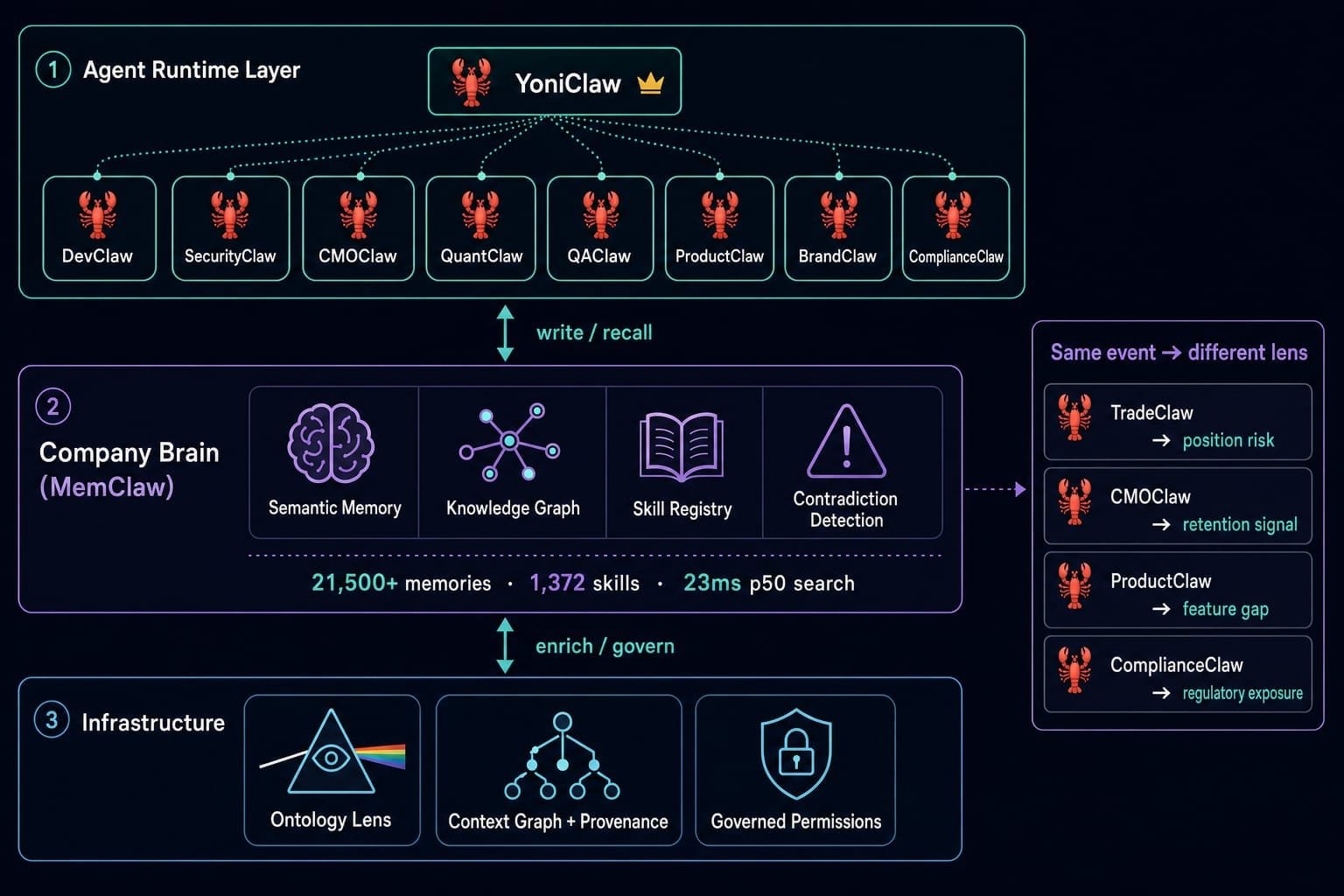
Built for teams running real agent fleets
Knowledge flows where it’s needed, stays locked where it shouldn’t, and every interaction makes the fleet smarter.
Marketing spots a competitor move— R&D recalls it in sprint planning
PII slips into a write— auto-detected, quarantined, never shared
An agent misses the right docs— its profile tunes itself, recall improves every query
See it in production
Real teams using MemClaw — from PR-review agents that remember why, to cross-vendor memory bridging Claude and ChatGPT.
Explore Use Cases →What you get out of the box
MemClaw vs. a typical AI memory layer
| Feature | MemClaw | Typical Memory Layer |
|---|---|---|
| Multi-agent fleet orchestration | ✅ Fleet-scoped, trust-gated | ❌ Single-agent focus |
| Per-agent search tuning | ✅ Auto-optimized profiles | ❌ One-size-fits-all |
| Contradiction detection | ✅ RDF triples + LLM | ❌ Not addressed |
| Memory lifecycle | ✅ 8 statuses, auto-transitions | ⚠️ Basic (active/archived) |
| Knowledge graph | ✅ Auto-extracted entities | ⚠️ Some (varies) |
| LLM enrichment | ✅ On every write | ⚠️ On write (varies) |
| Multi-tenant isolation | ✅ Row-level security | ⚠️ Namespace-based |
| Audit trail | ✅ Every operation | ❌ Limited or none |
| Crystallizer (dedup + cleanup) | ✅ LLM-powered batch | ❌ Manual or none |
| Raw vector search performance | ⚠️ pgvector (good) | ✅ Purpose-built indexes |
How it works
One loop, three pillars. Write, recall, and compound — every interaction makes the next one smarter.
Any agent writes
memclaw_write. LLM enriches in one pass — classify, extract entities, scan PII, detect contradictions, update the graph. Visibility scope and agent trust tier stamped at write time.
Any authorized agent recalls
memclaw_recall. Hybrid search (vector + graph + keyword), optional LLM briefings. Returns only what the caller’s scope and permissions allow. Every read audited.
Knowledge compounds
Per-agent tuning, LLM crystallizer merges duplicates, 8-status lifecycle transitions stale facts. The next recall is smarter than the last — and the loop repeats.
Policy your agents can’t ignore.
Permissions decide who can read what. Keystones decide what every agent must do.They’re mandatory rules — merged across tenant, fleet, and agent scope — fetched deterministically at session start and obeyed over any conflicting instruction. Set a policy once; it governs the whole fleet. Authoring takes trust ≥ 2.
How keystones work →Not another vector DB wrapper
A governed knowledge system built for multi-agent teams
Governed sharing
Visibility scopes, agent trust tiers, and audit trails on every operation. Built in, not bolted on.
Keystones
Mandatory policy rules, merged across tenant, fleet, and agent scope. Every agent obeys them at session start — overriding conflicting instructions.
Contradiction detection
Conflicting memories detected via RDF triples and LLM analysis. Old facts superseded. Knowledge stays clean.
Per-agent tuning
Each agent optimizes its own retrieval profile. Smarter search that compounds with every interaction.
Crystallizer
LLM consolidation merges near-duplicates into atomic facts. Source memories archived with full provenance.
Plus auto-enrichment, a live knowledge graph, hybrid search, and an 8-status memory lifecycle. See the full feature set in the docs →
Pricing
Unlimited agents. Unlimited fleets. Pay only for what you store and recall.
From the blog
Updates, deep dives, and case studies from the MemClaw team.
Caura-MemClaw is Open Source
Apache 2.0. The whole engine — storage, MCP tools, plugin, audit trail. Five minutes from git clone to a working memory layer.
Read →How eToro Built a Company Brain for 300+ AI Agents
The three-layer architecture a NASDAQ-listed fintech ($5.6B) built so 300+ specialized agents share memory. 26,500+ memories, 1,372 skills, 23 ms p50 search.
Read →Memory Isn’t Records
Six operations and one collection-based primitive that replaces a shelf of side-systems. Customer records, config, skills, playbooks — one tool.
Read →Frequently asked questions
Quick answers about how MemClaw works, how it differs from a vector DB, and how agents use it.
What is MemClaw?+
MemClaw is governed shared memory for AI agent fleets. It gives multi-agent systems cross-agent, cross-fleet recall with permissions, audit trails, and tenant isolation built in — plus self-learning through per-agent retrieval tuning and LLM crystallization.
How is MemClaw different from a vector database?+
MemClaw uses pgvector under the hood but is not a vector DB wrapper. It adds multi-agent fleet orchestration, per-agent retrieval tuning, contradiction detection, an 8-status memory lifecycle, a knowledge graph with auto-extracted entities, LLM enrichment on every write, row-level tenant isolation, audit trails on every op, and LLM-powered crystallization for dedup and cleanup.
Does MemClaw work with Claude Desktop, Cursor, or Windsurf?+
Yes. MemClaw speaks the Model Context Protocol (MCP). Paste a JSON config with your API key into any MCP-compatible client — Claude Desktop, Claude Code, Cursor, or Windsurf — and the tools appear immediately.
How is memory shared safely between agents and fleets?+
Every memory has a visibility scope, and every agent has a trust tier. Cross-fleet recall is permissioned and fully audited. Tenant isolation is enforced at the database row level, and PII is auto-detected and quarantined before it can cross fleet boundaries.
How do agents learn and improve over time?+
Each agent tunes its own retrieval profile based on feedback, so search quality compounds with every interaction. The LLM crystallizer merges near-duplicate memories into canonical atomic facts with full provenance. Lifecycle automation transitions memories through eight statuses (active, confirmed, outdated, superseded, archived, etc.) to keep knowledge clean without manual cleanup.
What does MemClaw cost?+
Free ($0): 10K memories, 5K writes/mo, 500 recalls/mo. Pro ($49/mo): 250K memories, 25K writes/mo, 3K recalls/mo. Business ($399/mo): 1M memories, 100K writes/mo, 10K recalls/mo. Custom (contact sales): custom limits, dedicated infra, SLA. Unlimited agents and fleets on every plan.
Is MemClaw open source?+
Yes — caura-memclaw is open source under Apache 2.0 at github.com/caura-ai/caura-memclaw. The whole engine: storage layer, 12 MCP tools, OpenClaw plugin, audit trail. The managed platform with governance wired in runs at memclaw.net.
Who builds MemClaw?+
MemClaw is built by Caura.ai as the governed memory platform for multi-agent AI systems.